Monday, 26 January 2015

What we did today - Flat Plans

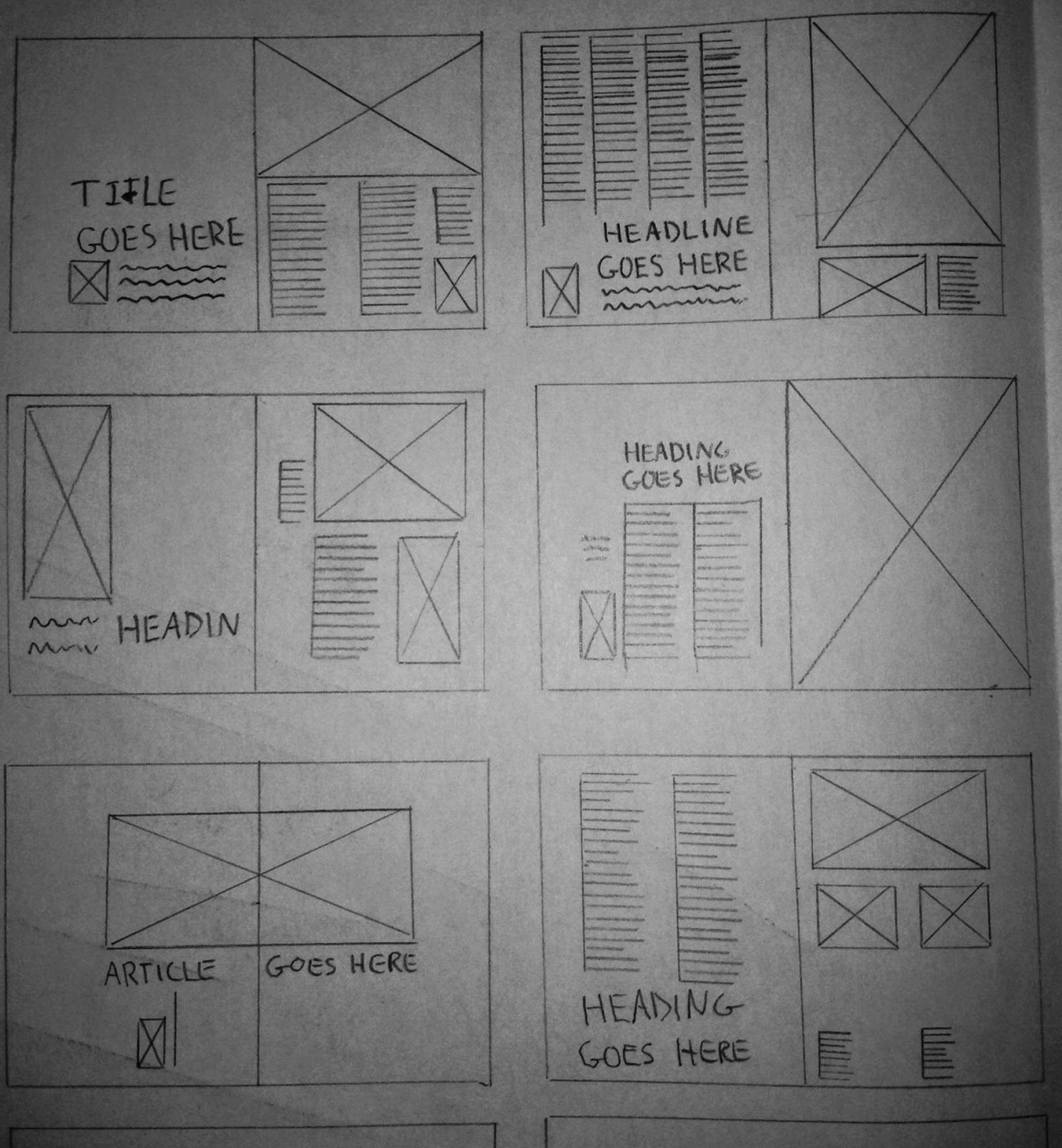
Double Page Spread - Layouts

Today we created page layouts for our magazines. This was necessary so we have a basic idea of how to set out double page spreads when it comes to creating our draft magazines. Below are 12 different layouts for a double page spread that I drew free hand - the big boxes with the crosses represent images and the lines represent text. 


Sunday, 25 January 2015

Research: Institution that would publish my magazine

Vice Media, Inc. 

Vice Media, Inc, better known as just 'Vice', is a youth media company and digital content creation studio. It owns and publishes magazines such as Vice and i-D. It is famous for its strong ties with youth culture and the alternative scene which make it the perfect institution to publish my magazine as Oscillate is aimed 16-25 year olds and the alt crowd. 

Vice was founded in 1994 by Shane Smith and Gavin Mclnnes and now runs a network of digital channels across the globe. This network covers everything from world news to fashion and to music. Vice currently operates a music channel called 'Noisey' which caters to the alt scene and provides a platform for artists to express their creative freedom. However unlike i-D it is not in magazine form. my magazine would be the Noisey equivalent of a vice music magazine. 


Audience Research

UK tribes


According the research that I conducted on UK tribes, 'hipsters' are a social group which would be drawn to my magazine as they are apparently 'epitomised by vice magazine', which my magazine draws inspiration from. Due to similarity between the fashion implemented by my magazine and magazines like i-D, this also means that there are similarities in our magazines audiences.

"Like the 60s Mods and Rockers and the 70s Punks, Hipsters are as ubiquitous as Chavs in their role defining UK youth culture in the 2000s...

Epitomised by Vice magazine, rampant trend-chasing and getting absolutely wasted, Hipsters are increasingly the most detested Tribe in the UK. Most likely to be used as a term of derision, Hipster is associated with lacking substance, arrogance, being unoriginal – and more often than not, with being a white middle-class uni student. Calling someone a Hipster may now be a mockery, but whichever way you cut it, the ‘Hipster look’ has definitely come to dominate the high street.

The Hipster look draws from punk rock and the 90s with a splatting of bygone subcultures for inspiration. From Soviet prison culture to Grunge, the Beatniks or ‘white trash’ chic – these disparate influences mean the Hipsters have driven millennial youth fashion trends more than any other Tribe. From skinny jeans to the vintage/retro revolution, acid bright colours to animal prints, Aztec print and dip-dye hair – Urban Outfitters brings off-the-shelf Hipster living to the Trendies. Hipsters popularised fixie bikes, grandma specs, made Lomography and Holga cameras a regular on teen Christmas lists – Red Stripe became the summer drink of choice, Ketamine the drug, and minimal tech the sound.

With so much influence, what’s our problem with these kids? Christian Lorentzen writes that Hipsters ‘fetishize the authentic and regurgitate it with a winking inauthenticity’ and this arrogance and try-hard nature really gets up the back of a generation proud of ‘keeping it real’. Hipsters’ break-neck turnover through fads (and huge spending power to support it) mean they are seen as lacking substance in real meaning by older Tribes, while younger teens recreate their super cool look and lifestyle in Claire’s Accessories. Is it fair for Hipsters to get such a bashing, while the close-by Trendies get by without a scratch?"

YOU GOV


The audience for my media product based on audience research would be hipsters and young alts aged from 18 - 25. According to audience research conducted on YouGov UK, the type of person typically interested in alt artists such as FKA twigs and King Krule are male aged 18 - 24, live in London and are interested in art, culture and fashion. For this reason my magazine fits this target audience perfectly as my magazine adopts a graphological and fashion style that’s popular amongst that scene. I also previously stated in my research and planning that I wished for my magazine to be published in London and Tokyo primarily, so this works well seeing as my target audience primarily live in London.


Friday, 23 January 2015

Research - Style Associated with Genre of Magazine

High Fashion/Street Fashion 


Because my magazine is aimed at a relatively young audience (16-25) and is aimed at the alternative scene, high fashion and street fashion would be the appropriate kind of style to implement within my magazine to appease my target audience. This type of fashion is also heavily associated with youth culture, which fits with my magazine perfectly.

Street style can trace its roots to Tokyo, London and NYC where street culture thrives. Street fashion is heavily brand orientated, with Stussy, Adidas, Supreme and Bape being among the most popular labels. Shops such as Urban Outfitters, Size? and Wellgosh are well known shops which are popular among the urban fashion scene as they sell the necessary brands.

Below is a list of some brands associated with street fashion:


Bape

Bape, short for 'A Bathing Ape' is a Japanese street wear founded in 1993 from Kyoto City. Since it's founding, the brand has been popular among youth culture and street fashion. Alternative artists such as Yung Lean and Kanye West are known to wear the brand.
Adidas

Adidas is a german sports wear brand. Arguably it is one of the most well known clothing brands in the world. Despite this, adidas remains popular within street culture and has almost become a staple.


Y-3

Y-3 is a collaboration effort between Japanese fashion designer Yohji Yamamoto and Adidas. It's essentially the high end fashion industry's answer to street style and is known for its avant-garde shoe design. With the release of it's Qasa shoe range, it's recently seen a surge in popularity with the street scene.


Comme des Garçons

Comme des Garçons (french for 'like the boys') is a Japanese fashion label founded in 1969. It's associated with high end fashion and is seen being on par with fashion labels such as Givenchy, Gucci and Yve Saint Lauren. However it's PLAY clothing line has become very popular with the street scene in recent years, with it's love heart logo being a popular symbol.
Supreme

Supreme is an American skateboarding clothing brand that was founded in NYC, 1994. It is well known for its bold logo and is particular popular for it's snapbacks and caps. It has collaborated with many other brands such as Comme des Garçons and Nike.


Stussy

Stussy is an American street-wear brand from Orange County in California. It was founded in 1983 and has since become a staple brand for street fashion. It's most popular for it's signature logo and t-shit designs.


Norse Projects

Norse Projects is Danish company from Copenhagen known for it's high quality and meticulously designed clothing. It was initially popular with the hipster scene however street fashion has recently adopted it into its style


High Fashion- Monotone // simplicity


A recent trend within high fashion is simplicity and monotone colour schemes. For my magazine, I will style my models in black and white coloured clothes to fit this trend. Below is a collage of style pictures associated with high fashion. As you can see, plain shirts, long overcoats and generally minimalistic clothing is what's most popular within high fashion at the moment. Because high fashion is easier to replicate, I will most likely be utilising this style within my magazine as opposed to just dressing my models in every street brand I can think of. The simplicity of high fashion also fits well with the way I plan to design my magazine (minimalistic & simplistic)


Wednesday, 21 January 2015

Research: Photographers

Patrick Demarchelier 

Patrick Demarchelier is a french photographer who specialises in fashion photography. He usually sticks to a black and white colour scheme and normally takes mid shot style photos. His photos tend to look very simplistic and naturalistic as the model doesn't usually wear excessive makeup in his shots. The black and white colour scheme he sticks to further bolsters the simplistic nature of his photography.


Terry Richardson 

Terry Richardson is an American photographer who specializes in fashion and portrait photography. He has worked for famous magazines such as i-D, Vogue and the Rolling stone and is known for his shot of the campaigns of famous brands such as Marc Jacobs, Supreme and Yves Saint Lauren. His photos tend to be fairly risqué and are very washed out, making the image appear very blank colour wise. 


Juergen Teller

Peter Lindbergh is a german photographer who again specialises in fashion photography. His photos are fairly colourful and are also naturalistic. However he seems to prefer to take his photos in naturalistic settings as opposed to taking them in front of white screens.